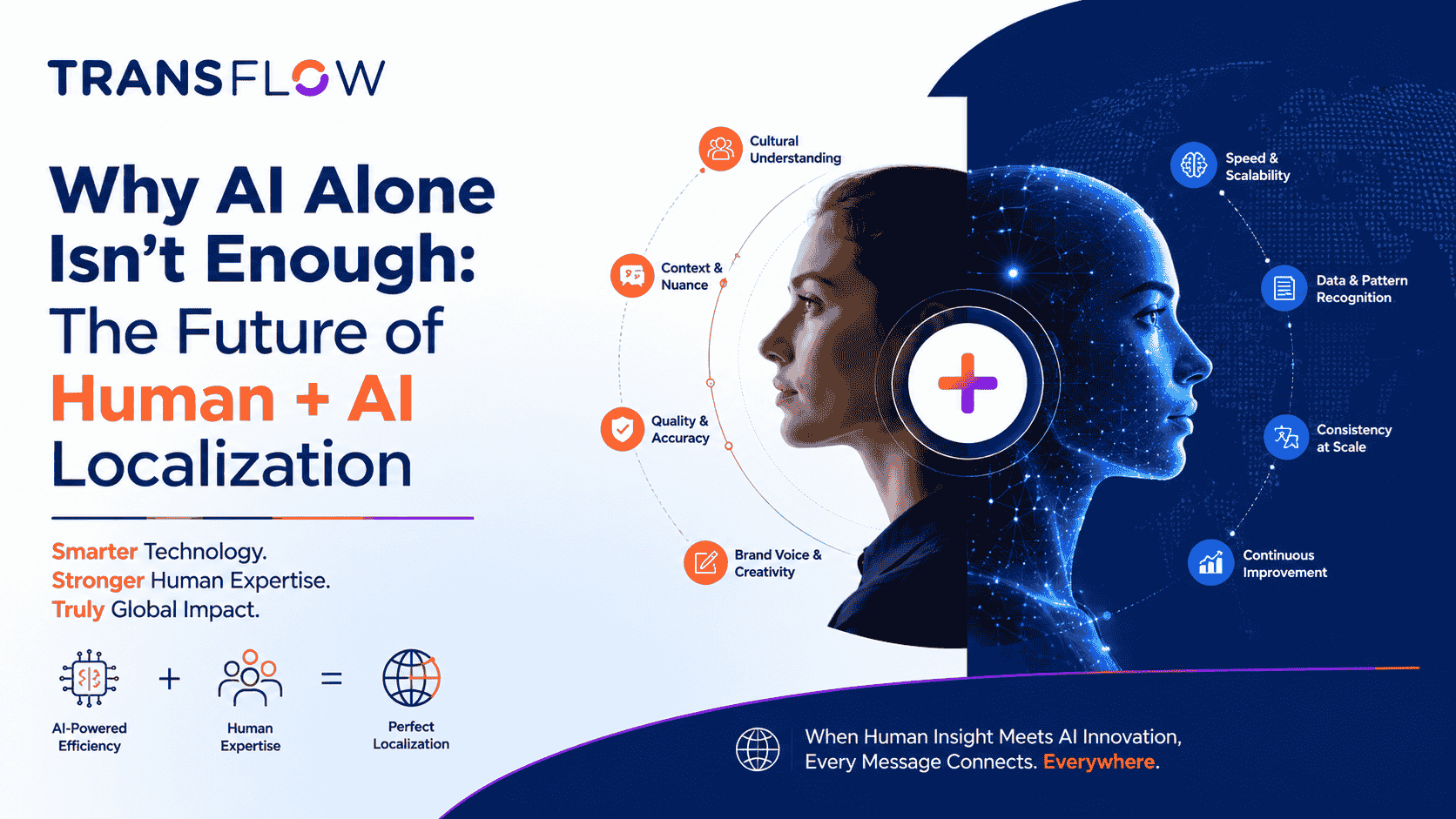
AI Can Translate Words. Humans Build Global Connections.
Introduction
Artificial Intelligence has transformed the translation and localization industry. Tasks that once took days can now be completed in minutes, enabling businesses to expand into global markets faster than ever before.
But as organizations increasingly rely on AI-generated translations, one important realization is becoming clear:
Speed alone doesn’t guarantee quality.
The future of localization is not AI replacing humans—it’s AI empowering human expertise.
The AI Revolution in Localization
Today’s AI-powered translation tools can:
- Translate large volumes of content instantly
- Translate large volumes of content instantly
- Support hundreds of languages
- Improve productivity through automation
- Reduce turnaround time for multilingual projects
These capabilities are helping businesses launch products globally at unprecedented speed.However, translation is about far more than converting words from one language to another.
Where AI Still Falls Short
Even the most advanced AI models can struggle with:
- Brand voice and tone
- Cultural nuances
- Industry-specific terminology
- Legal and regulatory accuracy
- Marketing creativity and emotional impact
A technically correct translation isn’t always the right translation.A message that resonates in one country may confuse—or even offend—customers in another.That’s where human expertise remains indispensable.
The Rise of Human + AI Localization
Modern localization leaders are adopting a hybrid approach:
- AI accelerates translation and repetitive workflows.
- Human linguists review, refine, and localize content for cultural accuracy.
- Subject matter experts ensure compliance across regulated industries.
- Quality assurance teams maintain consistency across every language.
This combination delivers the best of both worlds: Speed, scalability, and uncompromising quality. Industry leaders increasingly describe this as the new enterprise standard for multilingual content.
Why Businesses Need More Than Translation
Global customers expect content that feels local. Whether it’s:
- A healthcare document
- A banking application
- An eLearning course
- A software interface
- A marketing campaign
Users want experiences created specifically for their language and culture—not simply translated. That’s the true value of localization.
How Transflow Helps Global Businesses
At Transflow, we combine advanced AI-powered workflows with experienced native linguists and localization specialists to help organizations communicate confidently across global markets.
Our services include:
- Translation & Localization
- Website & App Localization
- Software Localization
- Multimedia Localization
- Voice-over & Dubbing
- Subtitling & Transcription
- Multilingual DTP
- eLearning Localization
- AI-assisted Translation Workflows
- Linguistic QA & Review
With support for 200+ languages, we help businesses scale globally while maintaining quality, consistency, and cultural relevance.
The Future Belongs to Hybrid Localization
AI will continue to redefine how multilingual content is created.But trust, accuracy, cultural understanding, and brand authenticity will always require human expertise.The future of global communication isn’t Human vs AI.
It’s Human + AI.
Organizations that embrace this hybrid approach will be the ones that connect with audiences more effectively, build stronger global brands, and accelerate international growth.
Conclusion
As global content volumes continue to grow, businesses need localization partners who combine innovation with linguistic excellence.At Transflow, we believe technology should enhance human expertise—not replace it.
Ready to expand globally with confidence?
Connect with Transflow and discover how intelligent localization can help your business reach every market, every language, and every customer.